How AI Hiring Platforms Reduce Recruiter Workload and Time-to-Hire
Hiring for one position sounds simple enough. Put out a job description, review applications, interview a few candidates and make an offer. Except the recruiter has 200 resumes to review, three interviewers who can't agree on a time, candidates waiting for updates and feedback scattered across different platforms. And that's just one open position. A survey of 109 respondents highlights where things get difficult. 54% identified manual screening as their biggest hiring challenge, followed by uneven candidate evaluation (25%), scattered tools (14%) and follow-up chaos (7%). These numbers point to a familiar problem: a lot of recruiting time goes into managing the process rather than actually getting to know the candidates. So, how can AI hiring platforms help?
A practical look at where recruitment teams lose time, what AI can take off their plates, and what still needs human judgment.
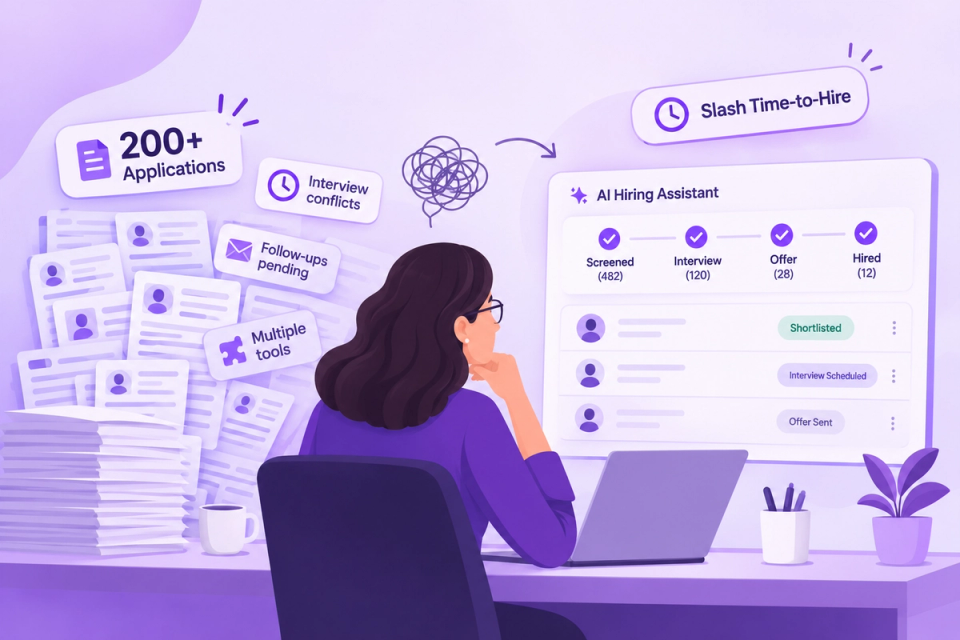
Hiring for one position sounds simple enough. Put out a job description, review applications, interview a few candidates and make an offer.
Except the recruiter has 200 resumes to review, three interviewers who can't agree on a time, candidates waiting for updates and feedback scattered across different platforms.
And that's just one open position.
A survey of 109 respondents highlights where things get difficult. 54% identified manual screening as their biggest hiring challenge, followed by uneven candidate evaluation (25%), scattered tools (14%) and follow-up chaos (7%).
These numbers point to a familiar problem: a lot of recruiting time goes into managing the process rather than actually getting to know the candidates.
So, how can AI hiring platforms help?
1. Resume Screening: When 200 Applications Land in Your Inbox
54% of respondents identified manual screening as their biggest challenge.
Anyone who has screened applications knows the routine. Open a resume, check the experience, compare it with the job description, move to the next one. Repeat until the shortlist starts taking shape.
Now imagine doing that for several open positions at once.
AI resume screening software can help by identifying relevant skills, matching experience against job requirements and organising applicants based on predefined criteria.
Platforms such as Workable and Phenom offer AI-assisted recruiting and candidate-matching capabilities.
The important distinction is that a relevant resume isn't necessarily a suitable candidate. AI can help narrow the pile, but recruiters still need to look beyond keywords and understand what someone can actually bring to the role.
2. Candidate Evaluation: Why Doesn't Everyone Agree on the Same Candidate?
25% of respondents reported uneven candidate evaluation.
A candidate performs well in a technical interview but struggles to explain their approach. Another communicates confidently but lacks the required depth. One interviewer gives a positive review, while another isn't convinced.
Without a consistent evaluation process, comparing candidates becomes difficult.
AI hiring platforms can introduce structured interviews, standardised questions and evaluation criteria to make assessments more consistent.
This is particularly useful during first-round interviews, where recruiters often ask similar questions across dozens of candidates.
Platforms like JustInterview.ai focus on AI-led interviews and structured candidate evaluation, helping hiring teams review candidates through a more consistent process.
The idea isn't to let AI decide whom to hire. It's to make sure candidates are assessed against the same expectations before human judgment takes over.
3. Too Many Recruitment Tools, Too Little Coordination
14% of respondents identified scattered tools as a hiring challenge.
The resume is in the ATS. The interview feedback is in someone's email. The candidate's availability is on a calendar, and the latest update is in a spreadsheet.
Recruiters often end up switching between platforms just to understand where one candidate stands.
AI recruitment software can simplify parts of this process through integrations, centralised candidate information and automated workflows.
For example, SmartRecruiters focuses on managing enterprise hiring workflows, while platforms like GoodTime help coordinate interviews across multiple calendars.
But adding another tool isn't always the answer. Before choosing an AI hiring platform, check whether it works with your existing systems or creates another place for your team to update.
4. Candidate Follow-ups: The Emails That Never Seem to End
7% of respondents identified follow-up chaos as their biggest challenge.
There's always someone waiting for an interview confirmation, someone asking for an update and someone who needs to reschedule.
Individually, these are small tasks. Across multiple open positions, they take up a surprising amount of time.
AI recruiting platforms like Paradox help automate candidate conversations, screening and interview scheduling. Automated reminders and communication workflows can also reduce the need for recruiters to follow up manually.
This matters beyond saving a few emails. Candidates who are left waiting too long may lose interest or accept another offer.
A timely update can make a difference between a candidate staying engaged and dropping out of the process.
5. Does AI Actually Reduce Time-to-Hire?
Reducing recruiter workload and speeding up time-to-hire are connected, but they aren't quite the same thing.
A platform might help screen 200 applications in less time. But if the shortlisted candidates spend another week waiting for interview slots, the hiring process hasn't moved forward by much.
The real benefit comes when AI reduces delays across multiple stages of recruitment.
Here's what to look for when comparing AI hiring platforms:
| Recruitment stage |
|---|
| What AI can help with |
When evaluating platforms, don't just ask how many tasks they automate. Ask how much recruiter time they save, whether candidates move through the process faster and whether the quality of evaluation remains consistent.
Track screening time, interview turnaround, candidate drop-offs and overall time-to-hire before and after implementation. These will give you a much clearer picture of whether the investment is working.
The Best AI Hiring Platform Is the One That Solves Your Biggest Bottleneck
Not every recruitment team struggles with the same thing. Some spend hours reviewing resumes, others lose time coordinating interviews, while some find it difficult to evaluate candidates consistently.
The right AI hiring platform depends on where your process needs the most help.
You don't necessarily need to automate everything at once. Start with the task that takes up the most recruiter time, find a tool that genuinely addresses it and measure what changes.
After all, recruiters already have enough people to talk to. They could do with fewer spreadsheets, fewer follow-up emails and fewer hours spent sorting through applications.
The time saved should go back to what matters: understanding candidates and finding the right person for the job.
Frequently asked questions
How do AI hiring platforms reduce recruiter workload?
They can assist with resume screening, structured interviews, scheduling, candidate communication and organising hiring information.
Can AI hiring platforms reduce time-to-hire?
They can reduce delays at individual stages, but the impact depends on how well the full hiring workflow is connected.
Should AI make the final hiring decision?
No. AI can organise information and support consistent evaluation, while recruiters and hiring managers retain decision-making responsibility.
Key takeaways
- Manual screening is the biggest challenge reported in the survey, at 54%.
- Structured interviews can make candidate evaluation more consistent.
- Integrations matter: another disconnected tool can create more work.
Based on JIA internal platform data across 5,000+ candidates.
Get started
Give your recruiters more time for the conversations that matter
See how a connected interview and evaluation workflow can reduce repetitive hiring work and help your team focus on better candidate decisions.