Choosing an AI Hiring Platform to Replace Separate Recruiting Tools
What should an enterprise evaluate when choosing an AI hiring platform to replace separate recruiting tools? Replacing recruiting software sounds like a straightforward decision. Find a platform that does more, costs less, and brings everything under one roof. Then reality sets in. There are candidate records accumulated over years, interview processes different teams have grown comfortable with, assessment tools connected to the ATS, and recruiters who already have their own way of getting things done. You aren't just replacing software. You're changing how people hire. And that deserves a closer look.
A decision checklist for enterprises weighing a more connected recruiting stack without disrupting the hiring processes they already rely on.
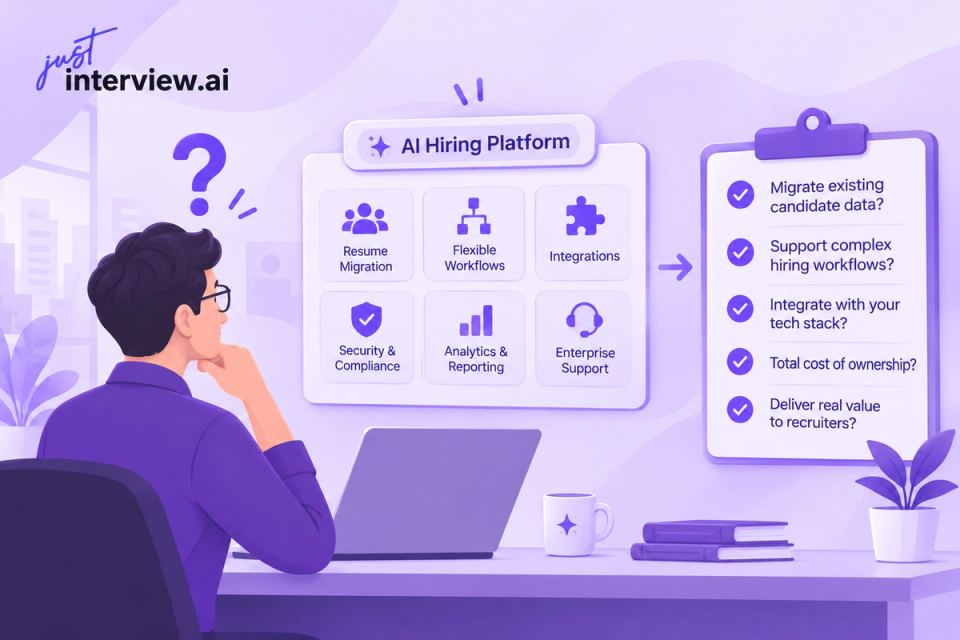
Replacing recruiting software sounds like a straightforward decision. Find a platform that does more, costs less, and brings everything under one roof.
Then reality sets in.
There are candidate records accumulated over years, interview processes different teams have grown comfortable with, assessment tools connected to the ATS, and recruiters who already have their own way of getting things done.
You aren't just replacing software. You're changing how people hire.
And that deserves a closer look.
1. Don't lose the history while trying to improve the future
A candidate's information rarely lives in one place. Their resume might be in an ATS, assessment results in another platform, and interview feedback buried in someone's notes.
When evaluating an AI hiring platform, ask what happens to all that information during the move.
Can existing candidate records be migrated? Will interview history and assessment results remain accessible? Can recruiters pick up where they left off?
A cleaner interface isn't much of an improvement if the team has to rebuild years of hiring context.
2. Will it fit the way your teams actually hire?
An enterprise rarely has one standard hiring process. Different departments, roles and locations may have different assessment stages, interview formats and approval requirements.
A platform might look impressive in a demo but struggle with the variations that happen every day.
Look at how easily it fits into existing hiring workflows. Can teams configure stages around different roles? Can hiring managers participate without adding more coordination for recruiters?
The best AI recruitment software shouldn't force every team into the same process just because it is easier to manage.
3. How much of your existing tech stack will still work?
An all-in-one platform doesn't automatically make every other tool unnecessary.
Your ATS, HRMS, calendar, assessment software and reporting systems may still need to exchange information. If they don't integrate properly, recruiters could end up copying candidate details between platforms all over again.
Before choosing, examine the available integrations, API support and data flow.
The point isn't simply to reduce the number of subscriptions. It's to reduce the number of times someone has to do the same work twice.
4. What does switching actually cost?
The subscription price is only one part of the investment.
There is implementation, data migration, employee training, workflow changes and the time teams spend adjusting to a new system. There is also the risk of slowing down active hiring while everything is being moved.
Ask about onboarding support, migration timelines, access controls, data security and how the platform handles growing hiring volumes.
Most importantly, understand what happens to live hiring processes during the transition.
A platform that saves money on paper may cost much more if the switch disrupts recruitment for weeks.
5. What will your recruiters get back?
This may be the most useful question of all.
Once the new platform is in place, will recruiters spend less time screening resumes, coordinating first-round interviews, chasing feedback and switching between tools?
Can hiring managers see candidate evaluations with enough context to make decisions? Can teams assess candidates more consistently? Can leadership understand where hiring is slowing down?
Measure the value of an AI hiring platform by the work it genuinely removes, not the number of features it promises.
The move should make hiring easier, not just software simpler
There is a reason enterprises accumulate separate recruiting tools. Each one probably solved a real problem at some point.
The challenge is that those solutions don't always work well together anymore.
So, when choosing an AI hiring platform, don't just ask what it can replace. Ask what it can preserve, what it can connect, and what it can make easier for the people using it every day.
Because the goal isn't to have fewer tools on the company's software bill.
It's to make hiring feel less like managing software and more like finding the right people.
Frequently asked questions
What should enterprises check before replacing recruiting software?
Review data migration, integrations, workflow flexibility, implementation effort, security and the effect on active hiring.
Does an all-in-one AI hiring platform replace an ATS?
Not automatically. Existing ATS, HRMS, calendar and reporting systems may still need to integrate with the new platform.
What is the hidden cost of switching recruiting tools?
Migration, implementation, training, workflow changes and disruption to active hiring can add to the subscription cost.
Key takeaways
- Protect candidate records, interview history and assessment results during migration.
- Test whether the platform can support different workflows across teams and roles.
- Check integrations and data flow before assuming an all-in-one system removes every other tool
- Evaluate the work removed for recruiters, not just the number of features or subscriptions.
Based on JIA internal platform data across 5,000+ candidates.
Get started
Make the move to simpler hiring workflows
Explore how structured interviews and connected candidate evaluation can fit into the recruiting systems your teams already use.