Best AI Hiring Platforms for Screening, Interviewing and Assessing Candidates
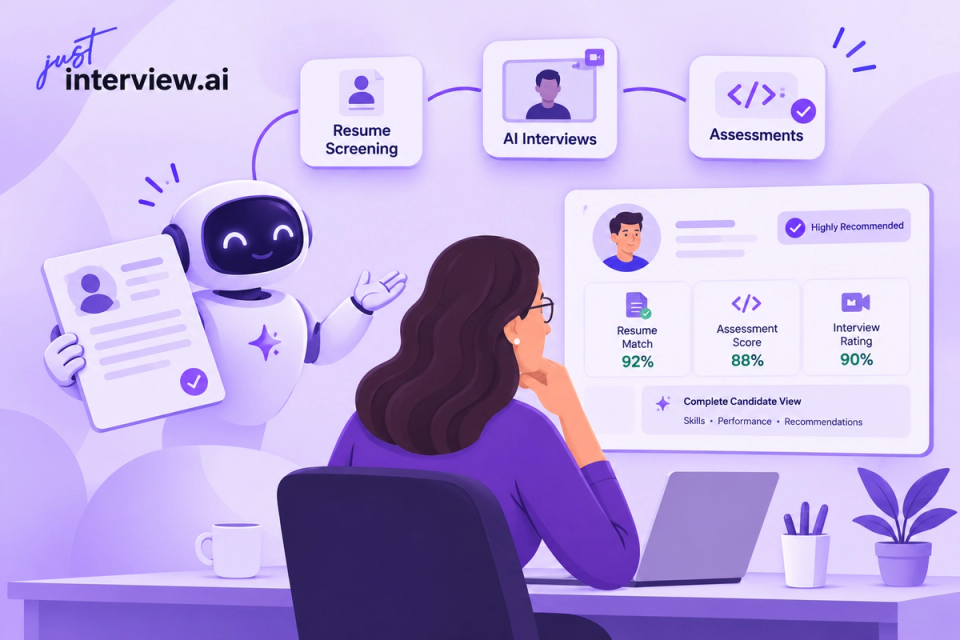
A candidate has a great resume but an average assessment score. Another doesn't look particularly impressive on paper but solves the task brilliantly and explains their thinking better than anyone else. Who gets shortlisted? It's a question hiring teams face more often than they might admit. We ask candidates to submit resumes, complete assessments and sit through interviews, sometimes using three different platforms to evaluate the same person. Yet, when it comes to making a hiring decision, we're still trying to piece together the whole picture. That's where AI hiring platforms are becoming interesting. Not simply because they automate screening or conduct interviews, but because they can bring different parts of candidate evaluation closer together.
This article looks at candidate evaluation as a connected process, rather than a collection of separate tests and reports.
A candidate has a great resume but an average assessment score. Another doesn't look particularly impressive on paper but solves the task brilliantly and explains their thinking better than anyone else.
Who gets shortlisted?
It's a question hiring teams face more often than they might admit. We ask candidates to submit resumes, complete assessments and sit through interviews, sometimes using three different platforms to evaluate the same person.
Yet, when it comes to making a hiring decision, we're still trying to piece together the whole picture.
That's where AI hiring platforms are becoming interesting. Not simply because they automate screening or conduct interviews, but because they can bring different parts of candidate evaluation closer together.
1. A resume tells you what someone has done. What about what they can do?
A resume is a good place to start, but it's hardly the whole story.
Someone might have the right job title, years of experience and all the keywords in the job description. But can they actually do the work?
AI candidate screening tools help recruiters sort applications, identify relevant experience and narrow down the shortlist. Platforms like HireVue and TestGorilla also offer broader assessment capabilities.
But here's something worth asking: Are we finding the best candidates, or simply finding the resumes that look most like the job description?
There's a difference.
2. The assessment says one thing and interview says another.
This is where hiring gets interesting.
A candidate scores well on a coding test but struggles to explain their approach. Another takes longer to solve the problem but demonstrates excellent reasoning.
Platforms like CodeSignal focus on technical assessments and coding interviews, while Vervoe uses practical, job-related simulations to evaluate candidates.
The bigger question is whether recruiters can use these results to have better interviews, rather than treating every stage as another elimination round.
3. Do we really need three different tools to understand one person?
Think about the typical hiring process. The resume is stored in an ATS. The assessment report comes from another platform. Interview notes sit in someone's inbox.
By the time the hiring manager reviews everything, the recruiter is often the one connecting the dots. Platforms like HireVue and Canditech bring together different interview and assessment capabilities, while specialist platforms such as CodeSignal focus more deeply on technical evaluation.
An integrated AI hiring workflow can make candidate information easier to follow. But having screening, interviewing and assessment features under one roof doesn't automatically make a platform better. What matters is whether the information from one stage actually helps the next.
4. What should the best AI hiring platforms actually help you see?
Forget the number of features for a moment.
When comparing AI hiring software, consider whether it helps your team answer a few important questions:
- Does the candidate have the experience required?
- Can they demonstrate the skills needed for the role?
- Can they explain their decisions and approach?
- Are interviewers evaluating candidates against consistent criteria?
- Can recruiters see the complete evaluation without piecing together multiple reports?
A good candidate assessment process shouldn't reduce someone to a number. It should give recruiters enough context to understand the person behind the result.
And AI should support that judgment, not replace it.
5. One platform or the right combination of tools?
There isn't necessarily one answer.
An engineering team might benefit from a specialist technical assessment platform alongside its existing ATS. A high-volume hiring team might prefer a broader interview and assessment solution. The right choice depends on what your current process is missing.
When comparing the best AI hiring platforms, look beyond how many stages they automate. Check how well they connect candidate screening, interviews, assessment results and feedback. Try following one candidate through the entire process. Does their information carry forward? Does the interviewer know what to explore? Can the hiring manager understand the final recommendation?
If the answer is yes, the platform is doing something more useful than simply automating tasks.
The person behind the scores
We spend a lot of time finding ways to measure candidates. More tests, more questions, more scores and more reports. But somewhere in all that, it's easy to lose sight of what we're actually trying to understand.
A resume, an assessment and an interview are three different windows into the same person. They shouldn't compete with one another; they should help complete the picture.
That's what AI hiring platforms should make easier: not just processing more candidates, but helping recruiters make sense of the ones in front of them.
Frequently asked questions
What should an AI hiring platform include?
Depending on hiring needs, it may include candidate screening, interviews, assessments and a way to bring evaluation results together.
Why combine interviews and assessments?
Each reveals a different part of a candidate’s capability; considered together, they provide more context than a single score.
Is an all-in-one hiring platform always better?
Not necessarily. The right choice depends on whether the tools connect meaningfully and support the roles being hired fo
Key takeaways
- A resume shows experience, but does not prove how someone performs.
- Assessment results become more useful when interviewers can explore the candidate’s reasoning.
- Connected information helps recruiters avoid piecing together reports from different platforms.
- The goal is a fuller view of the candidate, not simply more scores.
Based on JIA internal platform data across 5,000+ candidates.
Get started
See the candidate beyond the resume
Bring structured interviews and candidate evaluation into a clearer workflow, so your team has more context when it is time to make a decision.